
Revenue vs Profit: What’s the Difference for Small Businesses?
Revenue tells you how much your business sold, while profit tells you how much it actually kept. Learn how to calculate both, track your expenses, and use your numbers to make better business decisions.

If someone asked how much your business made last month, would you tell them your sales or your profit?
For many business owners, those two numbers feel like the same thing. After all, if ₦100,000 entered your account, it means you made ₦100,000, right?
Not exactly.
Understanding the difference between revenue and profit can help you make better decisions, price your products correctly, and know whether your business is actually growing.
In this guide, we’ll break down the difference between revenue and profit, and what they mean for your business.
What is Revenue?
Revenue is the total amount of money your business brings in from sales before you remove any costs or expenses.
Think of revenue as all the money that entered your business account from customers.
Let's say you sell clothing. In one month, you sold 100 dresses, and each dress costs ₦15,000.
Your revenue would be:
100 × ₦15,000 = ₦1,500,000
Revenue tells you how much your business sold. It does not tell you how much your business earned.
What is Profit?
Profit is the money left after you subtract all your business costs from your revenue. It’s what you actually keep from your sales after paying for everything it took to run the business.
Simple formula:
Profit = Revenue − Expenses
Expenses include things like:
- Cost of goods (what you paid suppliers for stock)
- Delivery and logistics
- Rent or shop space
- Data and internet
- Instagram and TikTok ads
- Staff salaries or commissions
- Packaging and branding
- Electricity and petrol costs
- Bank charges and payment fees
The reason many business owners confuse revenue and profit is simple: sales are easy to see. Expenses, debts, refunds, and other costs are much easier to overlook.
If you only track what's coming in and ignore what's going out, your business might look richer than it really is.
Simple Example: Revenue vs Profit
Let’s say you sell hair bundles. You sold 10 bundles for ₦50,000 each.
Revenue = 10 × ₦50,000 = ₦500,000
Now let’s look at your expenses:
- You bought the 10 bundles from your supplier for ₦15,000 each → ₦150,000
- You spent ₦20,000 on delivery and riders
- You ran Instagram ads for ₦100,000
- You used ₦50,000 for packaging and branding materials
Total expenses = ₦320,000
Now calculate profit:
Profit = Revenue − Expenses
Profit = ₦500,000 − ₦320,000 = ₦180,000
So:
- Revenue: ₦500,000 (what came in)
- Profit: ₦180,000 (what you kept)
That's the difference.
Why the Difference Matters
Imagine these two businesses:
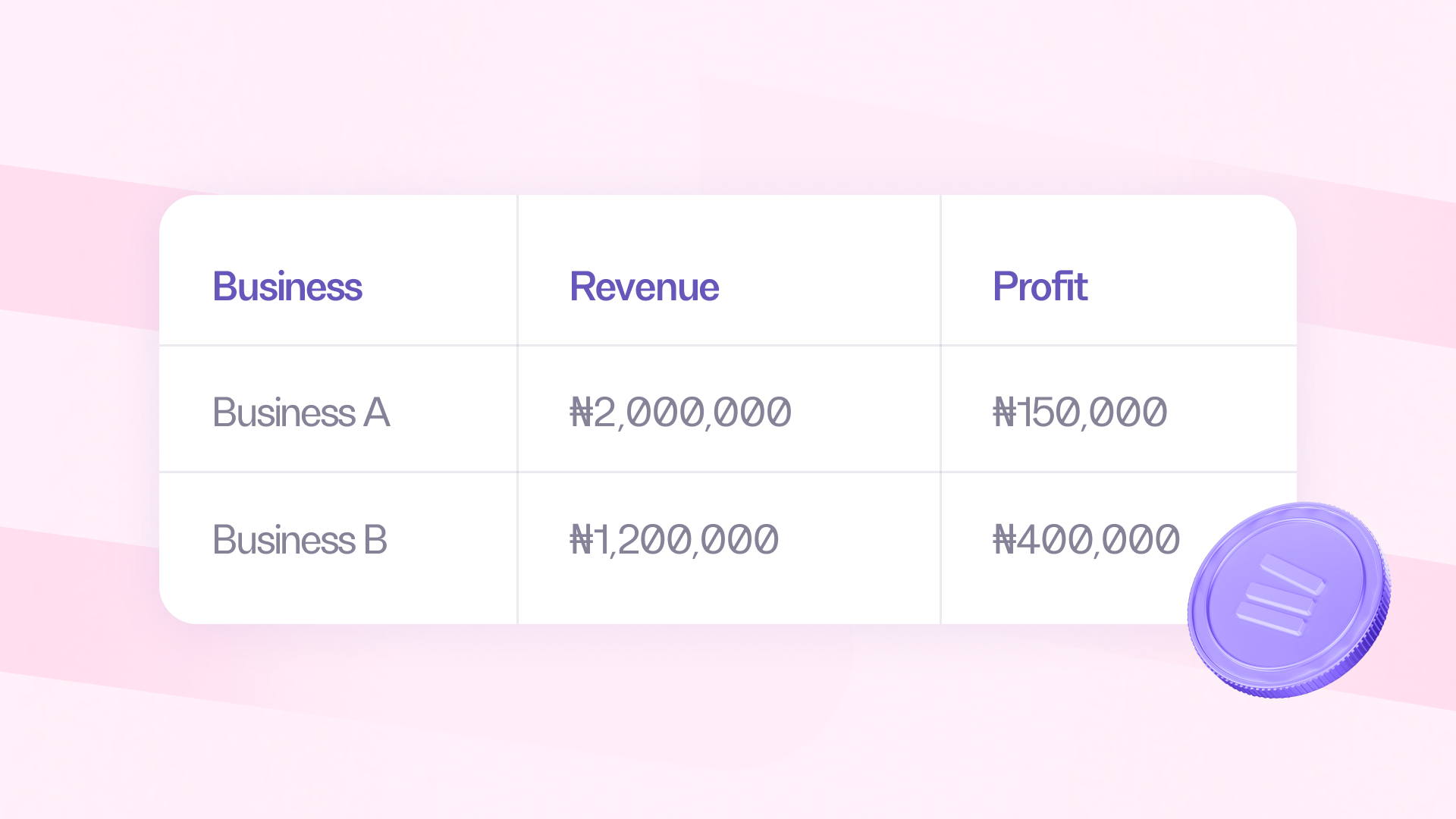
Business A made more sales, but Business B made more money.
If you only looked at revenue, you'd think Business A was performing better. But profit tells a different story.
This is why understanding the difference matters.
Why Revenue and Profit Both Matter
Revenue is your growth metric.
When revenue is increasing, it usually means more people are discovering your business, your marketing is working, or demand for your products is growing.
Looking at revenue over time can help you identify:
- Your best-selling products
- Seasonal trends
- Busy and slow periods
- Whether demand is growing or falling
But revenue stops at activity.
It tells you how much money passed through your business, not how much stayed.
Profit is what tells you whether the business is actually working for you.
Once you account for stock purchases, delivery costs, rent, internet, advertising, packaging, salaries, bank charges, and every other business expense, profit shows whether you're building a sustainable business.
Profit is the money that can:
- Pay you as the owner
- Help you restock without stress
- Fund marketing better
- Allow you to hire help
- Keep the business running during slower periods
Revenue shows how much you're selling.
Profit shows how much you're keeping.
How to Stop Confusing Revenue with Profit
Here are simple habits you can build into your business:
- Track every sale (revenue)
Don’t just rely on memory alone. Record:
- Product sold
- Quantity
- Selling price
- Date
The more accurate your sales records, the easier it becomes to calculate revenue.
- Record every business expense
Many business owners remember major expenses but forget the smaller ones. Things like:
- Delivery fees
- Packaging materials
- Data subscriptions
- Bank charges
- Transportation
These costs add up and quietly reduce your profit.
- Separate business and personal money
One of the fastest ways to lose track of profit is mixing business and personal spending. Avoid spending sales money casually. Pay yourself a fixed amount as salary, instead of dipping into business cash.
- Review your numbers regularly
At least weekly or monthly, sit down and ask:
- How much did I make? (Revenue)
- How much did I spend? (Expenses)
- What’s left? (Profit or loss)
- Use a System That Helps You Keep Accurate Records
The challenge for many business owners isn't understanding the difference between revenue and profit. It's keeping track of sales, expenses, customer debts, supplier payments, refunds, and everything else that affects profit. Using a system like Catlog that records what's coming in, what's going out, and what's left over makes it easier to work with your business data and numbers instead of estimates.
Why This Difference Matters for Your Decisions
When you understand revenue versus profit, you make better decisions like:
- Pricing: You stop copying competitor prices blindly and start pricing based on your actual costs and margins.
- Marketing spend: You can see whether spending ₦50,000 on ads is actually giving you more profit, not just more “sales screenshots.”You can see whether spending ₦50,000 on ads is generating more profit, not just more sales.
- Stock decisions: You’ll know which products bring good profit and which are just tying down your money.
- Growth plans: You can identify what's actually working and invest more confidently in the areas that drive results.
Conclusion
Once you understand the difference between revenue and profit, every other money decision in your business becomes clearer: your pricing, expenses, marketing, inventory purchases, your salary, and growth plan all become easier to evaluate.
Tracking what's coming into your business and what's going out helps with this decision.
Catlog's Money Tracker helps you track sales, expenses, debts, and profit in one place, making it easier to understand how your business is really performing and make decisions based on real numbers, not guesses.